Serving businesses regionally from Tennessee, Louisiana & Florida
(833) 820-2255
- ext 700
WHITE OLIVE CPA | FINANCIAL INSIGHTS

Can a CPA Help Choose the Right Corporate Structure for Taxes?

October 19, 2026

Can a CPA Help Choose the Right Corporate Structure for Taxes?

Choosing the right business structure is one of the most important financial decisions an entrepreneur can make. Whether you're launching a new company, expanding an established business, or reconsidering how your business is taxed, your entity structure can affect everything from tax obligations to administrative costs and long-term growth.

Many business owners begin with a sole proprietorship or limited liability company (LLC) without fully understanding how those structures affect their taxes.

As their businesses grow, they may wonder whether electing S corporation status, forming a corporation, or maintaining their current structure would be more beneficial.

Working with a Certified Public Accountant (CPA) can help business owners evaluate their options and understand the financial implications before making a decision.

At White Olive CPA, we help business owners approach tax planning with a clearer understanding of their financial circumstances and business goals.

Why Does Your Business Structure Matter for Taxes?

Your business structure determines how certain income is reported, how owners may be compensated, and which tax filing requirements apply.

Depending on the entity and tax elections involved, business owners may face different rules regarding:

  • Federal and state income taxes.
  • Self-employment and employment taxes.
  • Owner compensation and distributions.
  • Business deductions and losses.
  • Tax return filing requirements.
  • Estimated tax payments.
  • Ownership changes and succession planning.

The lowest apparent tax rate does not always mean a structure is the best financial choice.

Administrative costs, legal considerations, business profitability, and future plans should also influence the decision.

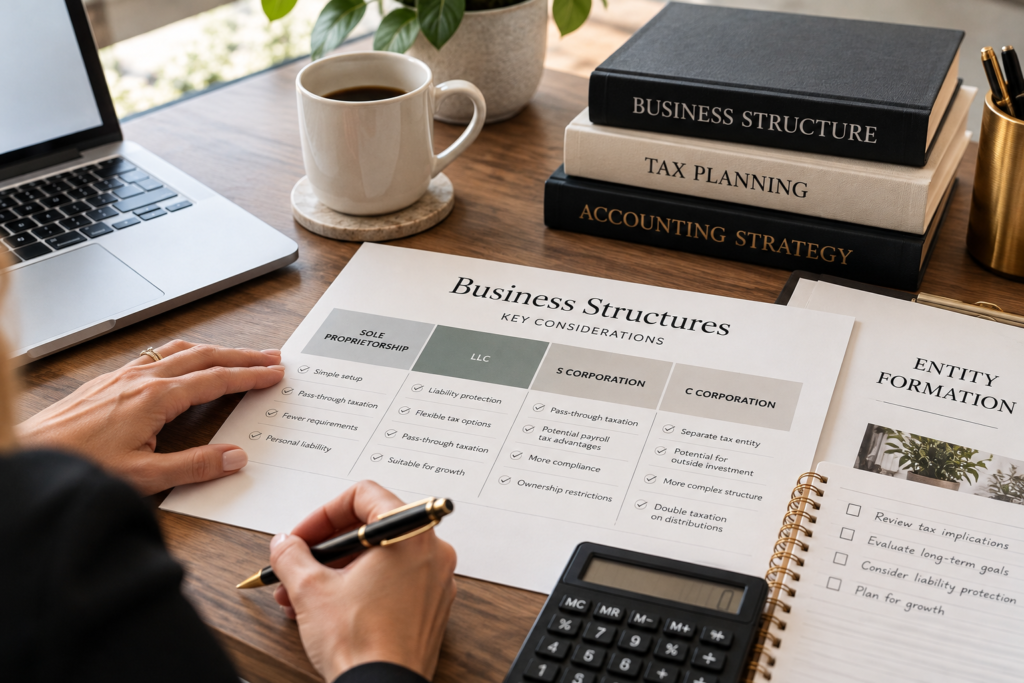
Understanding Common Business Structures

Sole Proprietorship

A sole proprietorship is generally the simplest form of business ownership.

For federal income tax purposes, business income and expenses are typically reported on the owner's individual tax return.

Potential advantages:

  • Relatively simple setup.
  • Fewer entity-level administrative requirements.
  • Straightforward federal income tax reporting.

Potential considerations:

  • The business is not legally separate from its owner.
  • Net earnings may be subject to self-employment tax.
  • Raising capital or adding owners can be more complicated.

Sole proprietorships may be appropriate for certain smaller operations, but owners should consider liability exposure and future growth plans.

Limited Liability Company (LLC)

An LLC is a business entity formed under state law.

LLCs are popular because they can provide liability protection under applicable state law while allowing flexibility in ownership and federal tax treatment.

For federal tax purposes, a single-member LLC is generally treated as a disregarded entity unless it elects corporate taxation. A multi-member LLC is generally taxed as a partnership unless it makes a different eligible election.

Potential advantages:

  • Liability protection under applicable state law.
  • Flexible ownership arrangements.
  • Multiple potential federal tax classifications.

Potential considerations:

  • State formation and ongoing compliance requirements.
  • Tax treatment depends on ownership and elections.
  • An LLC designation alone does not automatically reduce self-employment taxes.

An LLC is a legal structure, while S corporation status is a federal tax classification. An eligible LLC may elect S corporation taxation without becoming a state-law corporation.

S Corporation

An S corporation is a federal tax status available to qualifying corporations and eligible entities that make the appropriate election.

Generally, an S corporation passes income, losses, deductions, and credits through to shareholders for federal income tax purposes.

A shareholder who performs services for the business must receive reasonable compensation for those services.

Potential advantages:

  • Pass-through federal income tax treatment.
  • Potential employment tax advantages in appropriate circumstances.
  • A structure that may work well for certain profitable owner-operated businesses.

Potential considerations:

  • Reasonable compensation requirements.
  • Payroll administration and additional tax filings.
  • Eligibility restrictions involving shareholders and stock.
  • Additional accounting and compliance costs.

An S corporation election is not automatically beneficial for every small business.

A CPA can help evaluate whether potential tax savings justify the administrative responsibilities.

C Corporation

A C corporation is generally taxed as a separate entity for federal income tax purposes.

The corporation pays tax on its taxable income, and shareholders may also owe tax when profits are distributed as dividends.

Potential advantages:

  • Flexibility for certain ownership and investment structures.
  • Potential suitability for businesses seeking outside investors.
  • Corporate-level treatment that may support particular growth strategies.

Potential considerations:

  • Potential double taxation of corporate earnings distributed as dividends.
  • More extensive corporate formalities.
  • Additional reporting and administrative requirements.

C corporations may be appropriate for some businesses, particularly those with specific investment or expansion plans.

LLC vs. S Corporation: What's the Difference?

One of the most common questions business owners ask is whether they should operate as an LLC or S corporation.

The important distinction is that these terms describe different things.

An LLC is created under state law, while S corporation status is a federal tax election.

A qualifying LLC can elect to be taxed as an S corporation.

When evaluating this option, a CPA may review:

  • Annual business profitability.
  • The owner's role and responsibilities.
  • Reasonable compensation requirements.
  • Payroll administration costs.
  • State tax obligations.
  • Expected future growth.
  • The number and type of owners.

The potential benefits depend on the company's specific circumstances.

How Can a CPA Help You Choose the Right Structure?

1. Evaluate Your Current Financial Position

A CPA can review business revenue, expenses, profitability, and expected cash flow to understand how different tax structures might affect the company.

2. Compare Potential Tax Outcomes

Different structures may create different income tax, self-employment tax, and payroll tax consequences.

A CPA can help model potential scenarios rather than relying on generalized tax-saving claims.

3. Review Owner Compensation

How owners receive money from their businesses can affect tax reporting and compliance.

For example, S corporation shareholder-employees who perform services must receive reasonable wages.

A CPA can help business owners understand these rules and develop appropriate accounting and payroll processes.

4. Consider Long-Term Business Goals

The structure that works for a newly established business may not remain ideal as the company grows.

Future plans involving additional owners, outside investment, expansion, or succession should be considered.

5. Coordinate With Legal Professionals

Business entity selection involves legal issues as well as taxes.

A CPA can advise on financial and tax considerations, while an attorney can assist with liability protection, entity formation, operating agreements, and other legal matters.

Coordinating both perspectives can help owners make a more informed decision.

When Should You Reevaluate Your Business Structure?

Your business structure should not necessarily remain unchanged forever.

Consider reviewing it when:

  • Your business becomes consistently profitable.
  • You hire additional employees.
  • You add or remove business partners.
  • You expand into other states.
  • You seek outside investment.
  • You significantly change your compensation.
  • You plan to sell or transfer the business.

Regular tax planning can help ensure your structure continues to support your financial goals.

Common Mistakes Business Owners Should Avoid

Business owners sometimes make entity decisions based on incomplete information.

Common mistakes include:

  • Assuming every LLC automatically provides tax savings.
  • Electing S corporation status without evaluating payroll requirements.
  • Choosing a structure solely because another business uses it.
  • Overlooking state taxes and administrative costs.
  • Failing to update accounting procedures after an entity change.
  • Ignoring long-term ownership and growth plans.

Evaluating the complete financial picture can help prevent expensive mistakes.

Frequently Asked Questions

Is an LLC or S corporation better for taxes?

It depends on the business's profitability, ownership, compensation requirements, state tax obligations, and other factors. An eligible LLC can elect S corporation taxation, so the two are not mutually exclusive.

Can a CPA help me change my business tax classification?

Yes. A CPA can evaluate the potential tax consequences, explain applicable elections, and help with tax-related filings. Legal entity changes may also require an attorney.

Does forming an LLC automatically lower taxes?

No. Forming an LLC does not automatically change how business income is taxed federally. The tax treatment depends on ownership and any valid tax elections.

When should a business consider S corporation taxation?

It may be worth evaluating when the business has sufficient profitability to potentially justify reasonable owner wages and additional compliance costs. There is no universal income threshold that makes an election beneficial.

Can I change my business structure later?

Often, yes. However, changes may involve tax consequences, eligibility rules, filing deadlines, and legal requirements. Professional guidance is recommended before making a change.

Make Informed Business Decisions With White Olive CPA

Choosing a business structure involves more than selecting a name or filing formation paperwork.

Your decision can influence tax obligations, financial reporting, owner compensation, and future business opportunities.

At White Olive CPA, we help business owners understand their accounting and tax planning options so they can make informed financial decisions.

Whether you're starting a new business or reevaluating an established company, professional guidance can help you better understand the potential benefits and responsibilities of different structures.

Contact White Olive CPA today to discuss your business tax planning and accounting needs.

This article is provided for general educational purposes and is not individualized tax or legal advice. Business owners should consult qualified professionals regarding their specific circumstances.
WHITE OLIVE CPA | FINANCIAL INSIGHTS

Can a CPA Help Choose the Right Corporate Structure for Taxes?

October 19, 2026

Can a CPA Help Choose the Right Corporate Structure for Taxes?

Choosing the right business structure is one of the most important financial decisions an entrepreneur can make. Whether you're launching a new company, expanding an established business, or reconsidering how your business is taxed, your entity structure can affect everything from tax obligations to administrative costs and long-term growth.

Many business owners begin with a sole proprietorship or limited liability company (LLC) without fully understanding how those structures affect their taxes.

As their businesses grow, they may wonder whether electing S corporation status, forming a corporation, or maintaining their current structure would be more beneficial.

Working with a Certified Public Accountant (CPA) can help business owners evaluate their options and understand the financial implications before making a decision.

At White Olive CPA, we help business owners approach tax planning with a clearer understanding of their financial circumstances and business goals.

Why Does Your Business Structure Matter for Taxes?

Your business structure determines how certain income is reported, how owners may be compensated, and which tax filing requirements apply.

Depending on the entity and tax elections involved, business owners may face different rules regarding:

  • Federal and state income taxes.
  • Self-employment and employment taxes.
  • Owner compensation and distributions.
  • Business deductions and losses.
  • Tax return filing requirements.
  • Estimated tax payments.
  • Ownership changes and succession planning.

The lowest apparent tax rate does not always mean a structure is the best financial choice.

Administrative costs, legal considerations, business profitability, and future plans should also influence the decision.

Understanding Common Business Structures

Sole Proprietorship

A sole proprietorship is generally the simplest form of business ownership.

For federal income tax purposes, business income and expenses are typically reported on the owner's individual tax return.

Potential advantages:

  • Relatively simple setup.
  • Fewer entity-level administrative requirements.
  • Straightforward federal income tax reporting.

Potential considerations:

  • The business is not legally separate from its owner.
  • Net earnings may be subject to self-employment tax.
  • Raising capital or adding owners can be more complicated.

Sole proprietorships may be appropriate for certain smaller operations, but owners should consider liability exposure and future growth plans.

Limited Liability Company (LLC)

An LLC is a business entity formed under state law.

LLCs are popular because they can provide liability protection under applicable state law while allowing flexibility in ownership and federal tax treatment.

For federal tax purposes, a single-member LLC is generally treated as a disregarded entity unless it elects corporate taxation. A multi-member LLC is generally taxed as a partnership unless it makes a different eligible election.

Potential advantages:

  • Liability protection under applicable state law.
  • Flexible ownership arrangements.
  • Multiple potential federal tax classifications.

Potential considerations:

  • State formation and ongoing compliance requirements.
  • Tax treatment depends on ownership and elections.
  • An LLC designation alone does not automatically reduce self-employment taxes.

An LLC is a legal structure, while S corporation status is a federal tax classification. An eligible LLC may elect S corporation taxation without becoming a state-law corporation.

S Corporation

An S corporation is a federal tax status available to qualifying corporations and eligible entities that make the appropriate election.

Generally, an S corporation passes income, losses, deductions, and credits through to shareholders for federal income tax purposes.

A shareholder who performs services for the business must receive reasonable compensation for those services.

Potential advantages:

  • Pass-through federal income tax treatment.
  • Potential employment tax advantages in appropriate circumstances.
  • A structure that may work well for certain profitable owner-operated businesses.

Potential considerations:

  • Reasonable compensation requirements.
  • Payroll administration and additional tax filings.
  • Eligibility restrictions involving shareholders and stock.
  • Additional accounting and compliance costs.

An S corporation election is not automatically beneficial for every small business.

A CPA can help evaluate whether potential tax savings justify the administrative responsibilities.

C Corporation

A C corporation is generally taxed as a separate entity for federal income tax purposes.

The corporation pays tax on its taxable income, and shareholders may also owe tax when profits are distributed as dividends.

Potential advantages:

  • Flexibility for certain ownership and investment structures.
  • Potential suitability for businesses seeking outside investors.
  • Corporate-level treatment that may support particular growth strategies.

Potential considerations:

  • Potential double taxation of corporate earnings distributed as dividends.
  • More extensive corporate formalities.
  • Additional reporting and administrative requirements.

C corporations may be appropriate for some businesses, particularly those with specific investment or expansion plans.

LLC vs. S Corporation: What's the Difference?

One of the most common questions business owners ask is whether they should operate as an LLC or S corporation.

The important distinction is that these terms describe different things.

An LLC is created under state law, while S corporation status is a federal tax election.

A qualifying LLC can elect to be taxed as an S corporation.

When evaluating this option, a CPA may review:

  • Annual business profitability.
  • The owner's role and responsibilities.
  • Reasonable compensation requirements.
  • Payroll administration costs.
  • State tax obligations.
  • Expected future growth.
  • The number and type of owners.

The potential benefits depend on the company's specific circumstances.

How Can a CPA Help You Choose the Right Structure?

1. Evaluate Your Current Financial Position

A CPA can review business revenue, expenses, profitability, and expected cash flow to understand how different tax structures might affect the company.

2. Compare Potential Tax Outcomes

Different structures may create different income tax, self-employment tax, and payroll tax consequences.

A CPA can help model potential scenarios rather than relying on generalized tax-saving claims.

3. Review Owner Compensation

How owners receive money from their businesses can affect tax reporting and compliance.

For example, S corporation shareholder-employees who perform services must receive reasonable wages.

A CPA can help business owners understand these rules and develop appropriate accounting and payroll processes.

4. Consider Long-Term Business Goals

The structure that works for a newly established business may not remain ideal as the company grows.

Future plans involving additional owners, outside investment, expansion, or succession should be considered.

5. Coordinate With Legal Professionals

Business entity selection involves legal issues as well as taxes.

A CPA can advise on financial and tax considerations, while an attorney can assist with liability protection, entity formation, operating agreements, and other legal matters.

Coordinating both perspectives can help owners make a more informed decision.

When Should You Reevaluate Your Business Structure?

Your business structure should not necessarily remain unchanged forever.

Consider reviewing it when:

  • Your business becomes consistently profitable.
  • You hire additional employees.
  • You add or remove business partners.
  • You expand into other states.
  • You seek outside investment.
  • You significantly change your compensation.
  • You plan to sell or transfer the business.

Regular tax planning can help ensure your structure continues to support your financial goals.

Common Mistakes Business Owners Should Avoid

Business owners sometimes make entity decisions based on incomplete information.

Common mistakes include:

  • Assuming every LLC automatically provides tax savings.
  • Electing S corporation status without evaluating payroll requirements.
  • Choosing a structure solely because another business uses it.
  • Overlooking state taxes and administrative costs.
  • Failing to update accounting procedures after an entity change.
  • Ignoring long-term ownership and growth plans.

Evaluating the complete financial picture can help prevent expensive mistakes.

Frequently Asked Questions

Is an LLC or S corporation better for taxes?

It depends on the business's profitability, ownership, compensation requirements, state tax obligations, and other factors. An eligible LLC can elect S corporation taxation, so the two are not mutually exclusive.

Can a CPA help me change my business tax classification?

Yes. A CPA can evaluate the potential tax consequences, explain applicable elections, and help with tax-related filings. Legal entity changes may also require an attorney.

Does forming an LLC automatically lower taxes?

No. Forming an LLC does not automatically change how business income is taxed federally. The tax treatment depends on ownership and any valid tax elections.

When should a business consider S corporation taxation?

It may be worth evaluating when the business has sufficient profitability to potentially justify reasonable owner wages and additional compliance costs. There is no universal income threshold that makes an election beneficial.

Can I change my business structure later?

Often, yes. However, changes may involve tax consequences, eligibility rules, filing deadlines, and legal requirements. Professional guidance is recommended before making a change.

Make Informed Business Decisions With White Olive CPA

Choosing a business structure involves more than selecting a name or filing formation paperwork.

Your decision can influence tax obligations, financial reporting, owner compensation, and future business opportunities.

At White Olive CPA, we help business owners understand their accounting and tax planning options so they can make informed financial decisions.

Whether you're starting a new business or reevaluating an established company, professional guidance can help you better understand the potential benefits and responsibilities of different structures.

Contact White Olive CPA today to discuss your business tax planning and accounting needs.

This article is provided for general educational purposes and is not individualized tax or legal advice. Business owners should consult qualified professionals regarding their specific circumstances.

WHITE OLIVE CPA | FINANCIAL INSIGHTS

Can a CPA Help Choose the Right Corporate Structure for Taxes?

October 19, 2026

Can a CPA Help Choose the Right Corporate Structure for Taxes?

Choosing the right business structure is one of the most important financial decisions an entrepreneur can make. Whether you're launching a new company, expanding an established business, or reconsidering how your business is taxed, your entity structure can affect everything from tax obligations to administrative costs and long-term growth.

Many business owners begin with a sole proprietorship or limited liability company (LLC) without fully understanding how those structures affect their taxes.

As their businesses grow, they may wonder whether electing S corporation status, forming a corporation, or maintaining their current structure would be more beneficial.

Working with a Certified Public Accountant (CPA) can help business owners evaluate their options and understand the financial implications before making a decision.

At White Olive CPA, we help business owners approach tax planning with a clearer understanding of their financial circumstances and business goals.

Why Does Your Business Structure Matter for Taxes?

Your business structure determines how certain income is reported, how owners may be compensated, and which tax filing requirements apply.

Depending on the entity and tax elections involved, business owners may face different rules regarding:

  • Federal and state income taxes.
  • Self-employment and employment taxes.
  • Owner compensation and distributions.
  • Business deductions and losses.
  • Tax return filing requirements.
  • Estimated tax payments.
  • Ownership changes and succession planning.

The lowest apparent tax rate does not always mean a structure is the best financial choice.

Administrative costs, legal considerations, business profitability, and future plans should also influence the decision.

Understanding Common Business Structures

Sole Proprietorship

A sole proprietorship is generally the simplest form of business ownership.

For federal income tax purposes, business income and expenses are typically reported on the owner's individual tax return.

Potential advantages:

  • Relatively simple setup.
  • Fewer entity-level administrative requirements.
  • Straightforward federal income tax reporting.

Potential considerations:

  • The business is not legally separate from its owner.
  • Net earnings may be subject to self-employment tax.
  • Raising capital or adding owners can be more complicated.

Sole proprietorships may be appropriate for certain smaller operations, but owners should consider liability exposure and future growth plans.

Limited Liability Company (LLC)

An LLC is a business entity formed under state law.

LLCs are popular because they can provide liability protection under applicable state law while allowing flexibility in ownership and federal tax treatment.

For federal tax purposes, a single-member LLC is generally treated as a disregarded entity unless it elects corporate taxation. A multi-member LLC is generally taxed as a partnership unless it makes a different eligible election.

Potential advantages:

  • Liability protection under applicable state law.
  • Flexible ownership arrangements.
  • Multiple potential federal tax classifications.

Potential considerations:

  • State formation and ongoing compliance requirements.
  • Tax treatment depends on ownership and elections.
  • An LLC designation alone does not automatically reduce self-employment taxes.

An LLC is a legal structure, while S corporation status is a federal tax classification. An eligible LLC may elect S corporation taxation without becoming a state-law corporation.

S Corporation

An S corporation is a federal tax status available to qualifying corporations and eligible entities that make the appropriate election.

Generally, an S corporation passes income, losses, deductions, and credits through to shareholders for federal income tax purposes.

A shareholder who performs services for the business must receive reasonable compensation for those services.

Potential advantages:

  • Pass-through federal income tax treatment.
  • Potential employment tax advantages in appropriate circumstances.
  • A structure that may work well for certain profitable owner-operated businesses.

Potential considerations:

  • Reasonable compensation requirements.
  • Payroll administration and additional tax filings.
  • Eligibility restrictions involving shareholders and stock.
  • Additional accounting and compliance costs.

An S corporation election is not automatically beneficial for every small business.

A CPA can help evaluate whether potential tax savings justify the administrative responsibilities.

C Corporation

A C corporation is generally taxed as a separate entity for federal income tax purposes.

The corporation pays tax on its taxable income, and shareholders may also owe tax when profits are distributed as dividends.

Potential advantages:

  • Flexibility for certain ownership and investment structures.
  • Potential suitability for businesses seeking outside investors.
  • Corporate-level treatment that may support particular growth strategies.

Potential considerations:

  • Potential double taxation of corporate earnings distributed as dividends.
  • More extensive corporate formalities.
  • Additional reporting and administrative requirements.

C corporations may be appropriate for some businesses, particularly those with specific investment or expansion plans.

LLC vs. S Corporation: What's the Difference?

One of the most common questions business owners ask is whether they should operate as an LLC or S corporation.

The important distinction is that these terms describe different things.

An LLC is created under state law, while S corporation status is a federal tax election.

A qualifying LLC can elect to be taxed as an S corporation.

When evaluating this option, a CPA may review:

  • Annual business profitability.
  • The owner's role and responsibilities.
  • Reasonable compensation requirements.
  • Payroll administration costs.
  • State tax obligations.
  • Expected future growth.
  • The number and type of owners.

The potential benefits depend on the company's specific circumstances.

How Can a CPA Help You Choose the Right Structure?

1. Evaluate Your Current Financial Position

A CPA can review business revenue, expenses, profitability, and expected cash flow to understand how different tax structures might affect the company.

2. Compare Potential Tax Outcomes

Different structures may create different income tax, self-employment tax, and payroll tax consequences.

A CPA can help model potential scenarios rather than relying on generalized tax-saving claims.

3. Review Owner Compensation

How owners receive money from their businesses can affect tax reporting and compliance.

For example, S corporation shareholder-employees who perform services must receive reasonable wages.

A CPA can help business owners understand these rules and develop appropriate accounting and payroll processes.

4. Consider Long-Term Business Goals

The structure that works for a newly established business may not remain ideal as the company grows.

Future plans involving additional owners, outside investment, expansion, or succession should be considered.

5. Coordinate With Legal Professionals

Business entity selection involves legal issues as well as taxes.

A CPA can advise on financial and tax considerations, while an attorney can assist with liability protection, entity formation, operating agreements, and other legal matters.

Coordinating both perspectives can help owners make a more informed decision.

When Should You Reevaluate Your Business Structure?

Your business structure should not necessarily remain unchanged forever.

Consider reviewing it when:

  • Your business becomes consistently profitable.
  • You hire additional employees.
  • You add or remove business partners.
  • You expand into other states.
  • You seek outside investment.
  • You significantly change your compensation.
  • You plan to sell or transfer the business.

Regular tax planning can help ensure your structure continues to support your financial goals.

Common Mistakes Business Owners Should Avoid

Business owners sometimes make entity decisions based on incomplete information.

Common mistakes include:

  • Assuming every LLC automatically provides tax savings.
  • Electing S corporation status without evaluating payroll requirements.
  • Choosing a structure solely because another business uses it.
  • Overlooking state taxes and administrative costs.
  • Failing to update accounting procedures after an entity change.
  • Ignoring long-term ownership and growth plans.

Evaluating the complete financial picture can help prevent expensive mistakes.

Frequently Asked Questions

Is an LLC or S corporation better for taxes?

It depends on the business's profitability, ownership, compensation requirements, state tax obligations, and other factors. An eligible LLC can elect S corporation taxation, so the two are not mutually exclusive.

Can a CPA help me change my business tax classification?

Yes. A CPA can evaluate the potential tax consequences, explain applicable elections, and help with tax-related filings. Legal entity changes may also require an attorney.

Does forming an LLC automatically lower taxes?

No. Forming an LLC does not automatically change how business income is taxed federally. The tax treatment depends on ownership and any valid tax elections.

When should a business consider S corporation taxation?

It may be worth evaluating when the business has sufficient profitability to potentially justify reasonable owner wages and additional compliance costs. There is no universal income threshold that makes an election beneficial.

Can I change my business structure later?

Often, yes. However, changes may involve tax consequences, eligibility rules, filing deadlines, and legal requirements. Professional guidance is recommended before making a change.

Make Informed Business Decisions With White Olive CPA

Choosing a business structure involves more than selecting a name or filing formation paperwork.

Your decision can influence tax obligations, financial reporting, owner compensation, and future business opportunities.

At White Olive CPA, we help business owners understand their accounting and tax planning options so they can make informed financial decisions.

Whether you're starting a new business or reevaluating an established company, professional guidance can help you better understand the potential benefits and responsibilities of different structures.

Contact White Olive CPA today to discuss your business tax planning and accounting needs.

This article is provided for general educational purposes and is not individualized tax or legal advice. Business owners should consult qualified professionals regarding their specific circumstances.

WHITE OLIVE CPA | FINANCIAL INSIGHTS

Can a CPA Help Choose the Right Corporate Structure for Taxes?

October 19, 2026

Can a CPA Help Choose the Right Corporate Structure for Taxes?

Choosing the right business structure is one of the most important financial decisions an entrepreneur can make. Whether you're launching a new company, expanding an established business, or reconsidering how your business is taxed, your entity structure can affect everything from tax obligations to administrative costs and long-term growth.

Many business owners begin with a sole proprietorship or limited liability company (LLC) without fully understanding how those structures affect their taxes.

As their businesses grow, they may wonder whether electing S corporation status, forming a corporation, or maintaining their current structure would be more beneficial.

Working with a Certified Public Accountant (CPA) can help business owners evaluate their options and understand the financial implications before making a decision.

At White Olive CPA, we help business owners approach tax planning with a clearer understanding of their financial circumstances and business goals.

Why Does Your Business Structure Matter for Taxes?

Your business structure determines how certain income is reported, how owners may be compensated, and which tax filing requirements apply.

Depending on the entity and tax elections involved, business owners may face different rules regarding:

  • Federal and state income taxes.
  • Self-employment and employment taxes.
  • Owner compensation and distributions.
  • Business deductions and losses.
  • Tax return filing requirements.
  • Estimated tax payments.
  • Ownership changes and succession planning.

The lowest apparent tax rate does not always mean a structure is the best financial choice.

Administrative costs, legal considerations, business profitability, and future plans should also influence the decision.

Understanding Common Business Structures

Sole Proprietorship

A sole proprietorship is generally the simplest form of business ownership.

For federal income tax purposes, business income and expenses are typically reported on the owner's individual tax return.

Potential advantages:

  • Relatively simple setup.
  • Fewer entity-level administrative requirements.
  • Straightforward federal income tax reporting.

Potential considerations:

  • The business is not legally separate from its owner.
  • Net earnings may be subject to self-employment tax.
  • Raising capital or adding owners can be more complicated.

Sole proprietorships may be appropriate for certain smaller operations, but owners should consider liability exposure and future growth plans.

Limited Liability Company (LLC)

An LLC is a business entity formed under state law.

LLCs are popular because they can provide liability protection under applicable state law while allowing flexibility in ownership and federal tax treatment.

For federal tax purposes, a single-member LLC is generally treated as a disregarded entity unless it elects corporate taxation. A multi-member LLC is generally taxed as a partnership unless it makes a different eligible election.

Potential advantages:

  • Liability protection under applicable state law.
  • Flexible ownership arrangements.
  • Multiple potential federal tax classifications.

Potential considerations:

  • State formation and ongoing compliance requirements.
  • Tax treatment depends on ownership and elections.
  • An LLC designation alone does not automatically reduce self-employment taxes.

An LLC is a legal structure, while S corporation status is a federal tax classification. An eligible LLC may elect S corporation taxation without becoming a state-law corporation.

S Corporation

An S corporation is a federal tax status available to qualifying corporations and eligible entities that make the appropriate election.

Generally, an S corporation passes income, losses, deductions, and credits through to shareholders for federal income tax purposes.

A shareholder who performs services for the business must receive reasonable compensation for those services.

Potential advantages:

  • Pass-through federal income tax treatment.
  • Potential employment tax advantages in appropriate circumstances.
  • A structure that may work well for certain profitable owner-operated businesses.

Potential considerations:

  • Reasonable compensation requirements.
  • Payroll administration and additional tax filings.
  • Eligibility restrictions involving shareholders and stock.
  • Additional accounting and compliance costs.

An S corporation election is not automatically beneficial for every small business.

A CPA can help evaluate whether potential tax savings justify the administrative responsibilities.

C Corporation

A C corporation is generally taxed as a separate entity for federal income tax purposes.

The corporation pays tax on its taxable income, and shareholders may also owe tax when profits are distributed as dividends.

Potential advantages:

  • Flexibility for certain ownership and investment structures.
  • Potential suitability for businesses seeking outside investors.
  • Corporate-level treatment that may support particular growth strategies.

Potential considerations:

  • Potential double taxation of corporate earnings distributed as dividends.
  • More extensive corporate formalities.
  • Additional reporting and administrative requirements.

C corporations may be appropriate for some businesses, particularly those with specific investment or expansion plans.

LLC vs. S Corporation: What's the Difference?

One of the most common questions business owners ask is whether they should operate as an LLC or S corporation.

The important distinction is that these terms describe different things.

An LLC is created under state law, while S corporation status is a federal tax election.

A qualifying LLC can elect to be taxed as an S corporation.

When evaluating this option, a CPA may review:

  • Annual business profitability.
  • The owner's role and responsibilities.
  • Reasonable compensation requirements.
  • Payroll administration costs.
  • State tax obligations.
  • Expected future growth.
  • The number and type of owners.

The potential benefits depend on the company's specific circumstances.

How Can a CPA Help You Choose the Right Structure?

1. Evaluate Your Current Financial Position

A CPA can review business revenue, expenses, profitability, and expected cash flow to understand how different tax structures might affect the company.

2. Compare Potential Tax Outcomes

Different structures may create different income tax, self-employment tax, and payroll tax consequences.

A CPA can help model potential scenarios rather than relying on generalized tax-saving claims.

3. Review Owner Compensation

How owners receive money from their businesses can affect tax reporting and compliance.

For example, S corporation shareholder-employees who perform services must receive reasonable wages.

A CPA can help business owners understand these rules and develop appropriate accounting and payroll processes.

4. Consider Long-Term Business Goals

The structure that works for a newly established business may not remain ideal as the company grows.

Future plans involving additional owners, outside investment, expansion, or succession should be considered.

5. Coordinate With Legal Professionals

Business entity selection involves legal issues as well as taxes.

A CPA can advise on financial and tax considerations, while an attorney can assist with liability protection, entity formation, operating agreements, and other legal matters.

Coordinating both perspectives can help owners make a more informed decision.

When Should You Reevaluate Your Business Structure?

Your business structure should not necessarily remain unchanged forever.

Consider reviewing it when:

  • Your business becomes consistently profitable.
  • You hire additional employees.
  • You add or remove business partners.
  • You expand into other states.
  • You seek outside investment.
  • You significantly change your compensation.
  • You plan to sell or transfer the business.

Regular tax planning can help ensure your structure continues to support your financial goals.

Common Mistakes Business Owners Should Avoid

Business owners sometimes make entity decisions based on incomplete information.

Common mistakes include:

  • Assuming every LLC automatically provides tax savings.
  • Electing S corporation status without evaluating payroll requirements.
  • Choosing a structure solely because another business uses it.
  • Overlooking state taxes and administrative costs.
  • Failing to update accounting procedures after an entity change.
  • Ignoring long-term ownership and growth plans.

Evaluating the complete financial picture can help prevent expensive mistakes.

Frequently Asked Questions

Is an LLC or S corporation better for taxes?

It depends on the business's profitability, ownership, compensation requirements, state tax obligations, and other factors. An eligible LLC can elect S corporation taxation, so the two are not mutually exclusive.

Can a CPA help me change my business tax classification?

Yes. A CPA can evaluate the potential tax consequences, explain applicable elections, and help with tax-related filings. Legal entity changes may also require an attorney.

Does forming an LLC automatically lower taxes?

No. Forming an LLC does not automatically change how business income is taxed federally. The tax treatment depends on ownership and any valid tax elections.

When should a business consider S corporation taxation?

It may be worth evaluating when the business has sufficient profitability to potentially justify reasonable owner wages and additional compliance costs. There is no universal income threshold that makes an election beneficial.

Can I change my business structure later?

Often, yes. However, changes may involve tax consequences, eligibility rules, filing deadlines, and legal requirements. Professional guidance is recommended before making a change.

Make Informed Business Decisions With White Olive CPA

Choosing a business structure involves more than selecting a name or filing formation paperwork.

Your decision can influence tax obligations, financial reporting, owner compensation, and future business opportunities.

At White Olive CPA, we help business owners understand their accounting and tax planning options so they can make informed financial decisions.

Whether you're starting a new business or reevaluating an established company, professional guidance can help you better understand the potential benefits and responsibilities of different structures.

Contact White Olive CPA today to discuss your business tax planning and accounting needs.

This article is provided for general educational purposes and is not individualized tax or legal advice. Business owners should consult qualified professionals regarding their specific circumstances.

WHITE OLIVE CPA | FINANCIAL INSIGHTS

Can a CPA Help Choose the Right Corporate Structure for Taxes?

October 19, 2026

Can a CPA Help Choose the Right Corporate Structure for Taxes?

Choosing the right business structure is one of the most important financial decisions an entrepreneur can make. Whether you're launching a new company, expanding an established business, or reconsidering how your business is taxed, your entity structure can affect everything from tax obligations to administrative costs and long-term growth.

Many business owners begin with a sole proprietorship or limited liability company (LLC) without fully understanding how those structures affect their taxes.

As their businesses grow, they may wonder whether electing S corporation status, forming a corporation, or maintaining their current structure would be more beneficial.

Working with a Certified Public Accountant (CPA) can help business owners evaluate their options and understand the financial implications before making a decision.

At White Olive CPA, we help business owners approach tax planning with a clearer understanding of their financial circumstances and business goals.

Why Does Your Business Structure Matter for Taxes?

Your business structure determines how certain income is reported, how owners may be compensated, and which tax filing requirements apply.

Depending on the entity and tax elections involved, business owners may face different rules regarding:

  • Federal and state income taxes.
  • Self-employment and employment taxes.
  • Owner compensation and distributions.
  • Business deductions and losses.
  • Tax return filing requirements.
  • Estimated tax payments.
  • Ownership changes and succession planning.

The lowest apparent tax rate does not always mean a structure is the best financial choice.

Administrative costs, legal considerations, business profitability, and future plans should also influence the decision.

Understanding Common Business Structures

Sole Proprietorship

A sole proprietorship is generally the simplest form of business ownership.

For federal income tax purposes, business income and expenses are typically reported on the owner's individual tax return.

Potential advantages:

  • Relatively simple setup.
  • Fewer entity-level administrative requirements.
  • Straightforward federal income tax reporting.

Potential considerations:

  • The business is not legally separate from its owner.
  • Net earnings may be subject to self-employment tax.
  • Raising capital or adding owners can be more complicated.

Sole proprietorships may be appropriate for certain smaller operations, but owners should consider liability exposure and future growth plans.

Limited Liability Company (LLC)

An LLC is a business entity formed under state law.

LLCs are popular because they can provide liability protection under applicable state law while allowing flexibility in ownership and federal tax treatment.

For federal tax purposes, a single-member LLC is generally treated as a disregarded entity unless it elects corporate taxation. A multi-member LLC is generally taxed as a partnership unless it makes a different eligible election.

Potential advantages:

  • Liability protection under applicable state law.
  • Flexible ownership arrangements.
  • Multiple potential federal tax classifications.

Potential considerations:

  • State formation and ongoing compliance requirements.
  • Tax treatment depends on ownership and elections.
  • An LLC designation alone does not automatically reduce self-employment taxes.

An LLC is a legal structure, while S corporation status is a federal tax classification. An eligible LLC may elect S corporation taxation without becoming a state-law corporation.

S Corporation

An S corporation is a federal tax status available to qualifying corporations and eligible entities that make the appropriate election.

Generally, an S corporation passes income, losses, deductions, and credits through to shareholders for federal income tax purposes.

A shareholder who performs services for the business must receive reasonable compensation for those services.

Potential advantages:

  • Pass-through federal income tax treatment.
  • Potential employment tax advantages in appropriate circumstances.
  • A structure that may work well for certain profitable owner-operated businesses.

Potential considerations:

  • Reasonable compensation requirements.
  • Payroll administration and additional tax filings.
  • Eligibility restrictions involving shareholders and stock.
  • Additional accounting and compliance costs.

An S corporation election is not automatically beneficial for every small business.

A CPA can help evaluate whether potential tax savings justify the administrative responsibilities.

C Corporation

A C corporation is generally taxed as a separate entity for federal income tax purposes.

The corporation pays tax on its taxable income, and shareholders may also owe tax when profits are distributed as dividends.

Potential advantages:

  • Flexibility for certain ownership and investment structures.
  • Potential suitability for businesses seeking outside investors.
  • Corporate-level treatment that may support particular growth strategies.

Potential considerations:

  • Potential double taxation of corporate earnings distributed as dividends.
  • More extensive corporate formalities.
  • Additional reporting and administrative requirements.

C corporations may be appropriate for some businesses, particularly those with specific investment or expansion plans.

LLC vs. S Corporation: What's the Difference?

One of the most common questions business owners ask is whether they should operate as an LLC or S corporation.

The important distinction is that these terms describe different things.

An LLC is created under state law, while S corporation status is a federal tax election.

A qualifying LLC can elect to be taxed as an S corporation.

When evaluating this option, a CPA may review:

  • Annual business profitability.
  • The owner's role and responsibilities.
  • Reasonable compensation requirements.
  • Payroll administration costs.
  • State tax obligations.
  • Expected future growth.
  • The number and type of owners.

The potential benefits depend on the company's specific circumstances.

How Can a CPA Help You Choose the Right Structure?

1. Evaluate Your Current Financial Position

A CPA can review business revenue, expenses, profitability, and expected cash flow to understand how different tax structures might affect the company.

2. Compare Potential Tax Outcomes

Different structures may create different income tax, self-employment tax, and payroll tax consequences.

A CPA can help model potential scenarios rather than relying on generalized tax-saving claims.

3. Review Owner Compensation

How owners receive money from their businesses can affect tax reporting and compliance.

For example, S corporation shareholder-employees who perform services must receive reasonable wages.

A CPA can help business owners understand these rules and develop appropriate accounting and payroll processes.

4. Consider Long-Term Business Goals

The structure that works for a newly established business may not remain ideal as the company grows.

Future plans involving additional owners, outside investment, expansion, or succession should be considered.

5. Coordinate With Legal Professionals

Business entity selection involves legal issues as well as taxes.

A CPA can advise on financial and tax considerations, while an attorney can assist with liability protection, entity formation, operating agreements, and other legal matters.

Coordinating both perspectives can help owners make a more informed decision.

When Should You Reevaluate Your Business Structure?

Your business structure should not necessarily remain unchanged forever.

Consider reviewing it when:

  • Your business becomes consistently profitable.
  • You hire additional employees.
  • You add or remove business partners.
  • You expand into other states.
  • You seek outside investment.
  • You significantly change your compensation.
  • You plan to sell or transfer the business.

Regular tax planning can help ensure your structure continues to support your financial goals.

Common Mistakes Business Owners Should Avoid

Business owners sometimes make entity decisions based on incomplete information.

Common mistakes include:

  • Assuming every LLC automatically provides tax savings.
  • Electing S corporation status without evaluating payroll requirements.
  • Choosing a structure solely because another business uses it.
  • Overlooking state taxes and administrative costs.
  • Failing to update accounting procedures after an entity change.
  • Ignoring long-term ownership and growth plans.

Evaluating the complete financial picture can help prevent expensive mistakes.

Frequently Asked Questions

Is an LLC or S corporation better for taxes?

It depends on the business's profitability, ownership, compensation requirements, state tax obligations, and other factors. An eligible LLC can elect S corporation taxation, so the two are not mutually exclusive.

Can a CPA help me change my business tax classification?

Yes. A CPA can evaluate the potential tax consequences, explain applicable elections, and help with tax-related filings. Legal entity changes may also require an attorney.

Does forming an LLC automatically lower taxes?

No. Forming an LLC does not automatically change how business income is taxed federally. The tax treatment depends on ownership and any valid tax elections.

When should a business consider S corporation taxation?

It may be worth evaluating when the business has sufficient profitability to potentially justify reasonable owner wages and additional compliance costs. There is no universal income threshold that makes an election beneficial.

Can I change my business structure later?

Often, yes. However, changes may involve tax consequences, eligibility rules, filing deadlines, and legal requirements. Professional guidance is recommended before making a change.

Make Informed Business Decisions With White Olive CPA

Choosing a business structure involves more than selecting a name or filing formation paperwork.

Your decision can influence tax obligations, financial reporting, owner compensation, and future business opportunities.

At White Olive CPA, we help business owners understand their accounting and tax planning options so they can make informed financial decisions.

Whether you're starting a new business or reevaluating an established company, professional guidance can help you better understand the potential benefits and responsibilities of different structures.

Contact White Olive CPA today to discuss your business tax planning and accounting needs.

This article is provided for general educational purposes and is not individualized tax or legal advice. Business owners should consult qualified professionals regarding their specific circumstances.

WHITE OLIVE CPA | FINANCIAL INSIGHTS

Can a CPA Help Choose the Right Corporate Structure for Taxes?

October 19, 2026

Can a CPA Help Choose the Right Corporate Structure for Taxes?

Choosing the right business structure is one of the most important financial decisions an entrepreneur can make. Whether you're launching a new company, expanding an established business, or reconsidering how your business is taxed, your entity structure can affect everything from tax obligations to administrative costs and long-term growth.

Many business owners begin with a sole proprietorship or limited liability company (LLC) without fully understanding how those structures affect their taxes.

As their businesses grow, they may wonder whether electing S corporation status, forming a corporation, or maintaining their current structure would be more beneficial.

Working with a Certified Public Accountant (CPA) can help business owners evaluate their options and understand the financial implications before making a decision.

At White Olive CPA, we help business owners approach tax planning with a clearer understanding of their financial circumstances and business goals.

Why Does Your Business Structure Matter for Taxes?

Your business structure determines how certain income is reported, how owners may be compensated, and which tax filing requirements apply.

Depending on the entity and tax elections involved, business owners may face different rules regarding:

  • Federal and state income taxes.
  • Self-employment and employment taxes.
  • Owner compensation and distributions.
  • Business deductions and losses.
  • Tax return filing requirements.
  • Estimated tax payments.
  • Ownership changes and succession planning.

The lowest apparent tax rate does not always mean a structure is the best financial choice.

Administrative costs, legal considerations, business profitability, and future plans should also influence the decision.

Understanding Common Business Structures

Sole Proprietorship

A sole proprietorship is generally the simplest form of business ownership.

For federal income tax purposes, business income and expenses are typically reported on the owner's individual tax return.

Potential advantages:

  • Relatively simple setup.
  • Fewer entity-level administrative requirements.
  • Straightforward federal income tax reporting.

Potential considerations:

  • The business is not legally separate from its owner.
  • Net earnings may be subject to self-employment tax.
  • Raising capital or adding owners can be more complicated.

Sole proprietorships may be appropriate for certain smaller operations, but owners should consider liability exposure and future growth plans.

Limited Liability Company (LLC)

An LLC is a business entity formed under state law.

LLCs are popular because they can provide liability protection under applicable state law while allowing flexibility in ownership and federal tax treatment.

For federal tax purposes, a single-member LLC is generally treated as a disregarded entity unless it elects corporate taxation. A multi-member LLC is generally taxed as a partnership unless it makes a different eligible election.

Potential advantages:

  • Liability protection under applicable state law.
  • Flexible ownership arrangements.
  • Multiple potential federal tax classifications.

Potential considerations:

  • State formation and ongoing compliance requirements.
  • Tax treatment depends on ownership and elections.
  • An LLC designation alone does not automatically reduce self-employment taxes.

An LLC is a legal structure, while S corporation status is a federal tax classification. An eligible LLC may elect S corporation taxation without becoming a state-law corporation.

S Corporation

An S corporation is a federal tax status available to qualifying corporations and eligible entities that make the appropriate election.

Generally, an S corporation passes income, losses, deductions, and credits through to shareholders for federal income tax purposes.

A shareholder who performs services for the business must receive reasonable compensation for those services.

Potential advantages:

  • Pass-through federal income tax treatment.
  • Potential employment tax advantages in appropriate circumstances.
  • A structure that may work well for certain profitable owner-operated businesses.

Potential considerations:

  • Reasonable compensation requirements.
  • Payroll administration and additional tax filings.
  • Eligibility restrictions involving shareholders and stock.
  • Additional accounting and compliance costs.

An S corporation election is not automatically beneficial for every small business.

A CPA can help evaluate whether potential tax savings justify the administrative responsibilities.

C Corporation

A C corporation is generally taxed as a separate entity for federal income tax purposes.

The corporation pays tax on its taxable income, and shareholders may also owe tax when profits are distributed as dividends.

Potential advantages:

  • Flexibility for certain ownership and investment structures.
  • Potential suitability for businesses seeking outside investors.
  • Corporate-level treatment that may support particular growth strategies.

Potential considerations:

  • Potential double taxation of corporate earnings distributed as dividends.
  • More extensive corporate formalities.
  • Additional reporting and administrative requirements.

C corporations may be appropriate for some businesses, particularly those with specific investment or expansion plans.

LLC vs. S Corporation: What's the Difference?

One of the most common questions business owners ask is whether they should operate as an LLC or S corporation.

The important distinction is that these terms describe different things.

An LLC is created under state law, while S corporation status is a federal tax election.

A qualifying LLC can elect to be taxed as an S corporation.

When evaluating this option, a CPA may review:

  • Annual business profitability.
  • The owner's role and responsibilities.
  • Reasonable compensation requirements.
  • Payroll administration costs.
  • State tax obligations.
  • Expected future growth.
  • The number and type of owners.

The potential benefits depend on the company's specific circumstances.

How Can a CPA Help You Choose the Right Structure?

1. Evaluate Your Current Financial Position

A CPA can review business revenue, expenses, profitability, and expected cash flow to understand how different tax structures might affect the company.

2. Compare Potential Tax Outcomes

Different structures may create different income tax, self-employment tax, and payroll tax consequences.

A CPA can help model potential scenarios rather than relying on generalized tax-saving claims.

3. Review Owner Compensation

How owners receive money from their businesses can affect tax reporting and compliance.

For example, S corporation shareholder-employees who perform services must receive reasonable wages.

A CPA can help business owners understand these rules and develop appropriate accounting and payroll processes.

4. Consider Long-Term Business Goals

The structure that works for a newly established business may not remain ideal as the company grows.

Future plans involving additional owners, outside investment, expansion, or succession should be considered.

5. Coordinate With Legal Professionals

Business entity selection involves legal issues as well as taxes.

A CPA can advise on financial and tax considerations, while an attorney can assist with liability protection, entity formation, operating agreements, and other legal matters.

Coordinating both perspectives can help owners make a more informed decision.

When Should You Reevaluate Your Business Structure?

Your business structure should not necessarily remain unchanged forever.

Consider reviewing it when:

  • Your business becomes consistently profitable.
  • You hire additional employees.
  • You add or remove business partners.
  • You expand into other states.
  • You seek outside investment.
  • You significantly change your compensation.
  • You plan to sell or transfer the business.

Regular tax planning can help ensure your structure continues to support your financial goals.

Common Mistakes Business Owners Should Avoid

Business owners sometimes make entity decisions based on incomplete information.

Common mistakes include:

  • Assuming every LLC automatically provides tax savings.
  • Electing S corporation status without evaluating payroll requirements.
  • Choosing a structure solely because another business uses it.
  • Overlooking state taxes and administrative costs.
  • Failing to update accounting procedures after an entity change.
  • Ignoring long-term ownership and growth plans.

Evaluating the complete financial picture can help prevent expensive mistakes.

Frequently Asked Questions

Is an LLC or S corporation better for taxes?

It depends on the business's profitability, ownership, compensation requirements, state tax obligations, and other factors. An eligible LLC can elect S corporation taxation, so the two are not mutually exclusive.

Can a CPA help me change my business tax classification?

Yes. A CPA can evaluate the potential tax consequences, explain applicable elections, and help with tax-related filings. Legal entity changes may also require an attorney.

Does forming an LLC automatically lower taxes?

No. Forming an LLC does not automatically change how business income is taxed federally. The tax treatment depends on ownership and any valid tax elections.

When should a business consider S corporation taxation?

It may be worth evaluating when the business has sufficient profitability to potentially justify reasonable owner wages and additional compliance costs. There is no universal income threshold that makes an election beneficial.

Can I change my business structure later?

Often, yes. However, changes may involve tax consequences, eligibility rules, filing deadlines, and legal requirements. Professional guidance is recommended before making a change.

Make Informed Business Decisions With White Olive CPA

Choosing a business structure involves more than selecting a name or filing formation paperwork.

Your decision can influence tax obligations, financial reporting, owner compensation, and future business opportunities.

At White Olive CPA, we help business owners understand their accounting and tax planning options so they can make informed financial decisions.

Whether you're starting a new business or reevaluating an established company, professional guidance can help you better understand the potential benefits and responsibilities of different structures.

Contact White Olive CPA today to discuss your business tax planning and accounting needs.

This article is provided for general educational purposes and is not individualized tax or legal advice. Business owners should consult qualified professionals regarding their specific circumstances.

WHITE OLIVE CPA | FINANCIAL INSIGHTS

Can a CPA Help Choose the Right Corporate Structure for Taxes?

October 19, 2026

Can a CPA Help Choose the Right Corporate Structure for Taxes?

Choosing the right business structure is one of the most important financial decisions an entrepreneur can make. Whether you're launching a new company, expanding an established business, or reconsidering how your business is taxed, your entity structure can affect everything from tax obligations to administrative costs and long-term growth.

Many business owners begin with a sole proprietorship or limited liability company (LLC) without fully understanding how those structures affect their taxes.

As their businesses grow, they may wonder whether electing S corporation status, forming a corporation, or maintaining their current structure would be more beneficial.

Working with a Certified Public Accountant (CPA) can help business owners evaluate their options and understand the financial implications before making a decision.

At White Olive CPA, we help business owners approach tax planning with a clearer understanding of their financial circumstances and business goals.

Why Does Your Business Structure Matter for Taxes?

Your business structure determines how certain income is reported, how owners may be compensated, and which tax filing requirements apply.

Depending on the entity and tax elections involved, business owners may face different rules regarding:

  • Federal and state income taxes.
  • Self-employment and employment taxes.
  • Owner compensation and distributions.
  • Business deductions and losses.
  • Tax return filing requirements.
  • Estimated tax payments.
  • Ownership changes and succession planning.

The lowest apparent tax rate does not always mean a structure is the best financial choice.

Administrative costs, legal considerations, business profitability, and future plans should also influence the decision.

Understanding Common Business Structures

Sole Proprietorship

A sole proprietorship is generally the simplest form of business ownership.

For federal income tax purposes, business income and expenses are typically reported on the owner's individual tax return.

Potential advantages:

  • Relatively simple setup.
  • Fewer entity-level administrative requirements.
  • Straightforward federal income tax reporting.

Potential considerations:

  • The business is not legally separate from its owner.
  • Net earnings may be subject to self-employment tax.
  • Raising capital or adding owners can be more complicated.

Sole proprietorships may be appropriate for certain smaller operations, but owners should consider liability exposure and future growth plans.

Limited Liability Company (LLC)

An LLC is a business entity formed under state law.

LLCs are popular because they can provide liability protection under applicable state law while allowing flexibility in ownership and federal tax treatment.

For federal tax purposes, a single-member LLC is generally treated as a disregarded entity unless it elects corporate taxation. A multi-member LLC is generally taxed as a partnership unless it makes a different eligible election.

Potential advantages:

  • Liability protection under applicable state law.
  • Flexible ownership arrangements.
  • Multiple potential federal tax classifications.

Potential considerations:

  • State formation and ongoing compliance requirements.
  • Tax treatment depends on ownership and elections.
  • An LLC designation alone does not automatically reduce self-employment taxes.

An LLC is a legal structure, while S corporation status is a federal tax classification. An eligible LLC may elect S corporation taxation without becoming a state-law corporation.

S Corporation

An S corporation is a federal tax status available to qualifying corporations and eligible entities that make the appropriate election.

Generally, an S corporation passes income, losses, deductions, and credits through to shareholders for federal income tax purposes.

A shareholder who performs services for the business must receive reasonable compensation for those services.

Potential advantages:

  • Pass-through federal income tax treatment.
  • Potential employment tax advantages in appropriate circumstances.
  • A structure that may work well for certain profitable owner-operated businesses.

Potential considerations:

  • Reasonable compensation requirements.
  • Payroll administration and additional tax filings.
  • Eligibility restrictions involving shareholders and stock.
  • Additional accounting and compliance costs.

An S corporation election is not automatically beneficial for every small business.

A CPA can help evaluate whether potential tax savings justify the administrative responsibilities.

C Corporation

A C corporation is generally taxed as a separate entity for federal income tax purposes.

The corporation pays tax on its taxable income, and shareholders may also owe tax when profits are distributed as dividends.

Potential advantages:

  • Flexibility for certain ownership and investment structures.
  • Potential suitability for businesses seeking outside investors.
  • Corporate-level treatment that may support particular growth strategies.

Potential considerations:

  • Potential double taxation of corporate earnings distributed as dividends.
  • More extensive corporate formalities.
  • Additional reporting and administrative requirements.

C corporations may be appropriate for some businesses, particularly those with specific investment or expansion plans.

LLC vs. S Corporation: What's the Difference?

One of the most common questions business owners ask is whether they should operate as an LLC or S corporation.

The important distinction is that these terms describe different things.

An LLC is created under state law, while S corporation status is a federal tax election.

A qualifying LLC can elect to be taxed as an S corporation.

When evaluating this option, a CPA may review:

  • Annual business profitability.
  • The owner's role and responsibilities.
  • Reasonable compensation requirements.
  • Payroll administration costs.
  • State tax obligations.
  • Expected future growth.
  • The number and type of owners.

The potential benefits depend on the company's specific circumstances.

How Can a CPA Help You Choose the Right Structure?

1. Evaluate Your Current Financial Position

A CPA can review business revenue, expenses, profitability, and expected cash flow to understand how different tax structures might affect the company.

2. Compare Potential Tax Outcomes

Different structures may create different income tax, self-employment tax, and payroll tax consequences.

A CPA can help model potential scenarios rather than relying on generalized tax-saving claims.

3. Review Owner Compensation

How owners receive money from their businesses can affect tax reporting and compliance.

For example, S corporation shareholder-employees who perform services must receive reasonable wages.

A CPA can help business owners understand these rules and develop appropriate accounting and payroll processes.

4. Consider Long-Term Business Goals

The structure that works for a newly established business may not remain ideal as the company grows.

Future plans involving additional owners, outside investment, expansion, or succession should be considered.

5. Coordinate With Legal Professionals

Business entity selection involves legal issues as well as taxes.

A CPA can advise on financial and tax considerations, while an attorney can assist with liability protection, entity formation, operating agreements, and other legal matters.

Coordinating both perspectives can help owners make a more informed decision.

When Should You Reevaluate Your Business Structure?

Your business structure should not necessarily remain unchanged forever.

Consider reviewing it when:

  • Your business becomes consistently profitable.
  • You hire additional employees.
  • You add or remove business partners.
  • You expand into other states.
  • You seek outside investment.
  • You significantly change your compensation.
  • You plan to sell or transfer the business.

Regular tax planning can help ensure your structure continues to support your financial goals.

Common Mistakes Business Owners Should Avoid

Business owners sometimes make entity decisions based on incomplete information.

Common mistakes include:

  • Assuming every LLC automatically provides tax savings.
  • Electing S corporation status without evaluating payroll requirements.
  • Choosing a structure solely because another business uses it.
  • Overlooking state taxes and administrative costs.
  • Failing to update accounting procedures after an entity change.
  • Ignoring long-term ownership and growth plans.

Evaluating the complete financial picture can help prevent expensive mistakes.

Frequently Asked Questions

Is an LLC or S corporation better for taxes?

It depends on the business's profitability, ownership, compensation requirements, state tax obligations, and other factors. An eligible LLC can elect S corporation taxation, so the two are not mutually exclusive.

Can a CPA help me change my business tax classification?

Yes. A CPA can evaluate the potential tax consequences, explain applicable elections, and help with tax-related filings. Legal entity changes may also require an attorney.

Does forming an LLC automatically lower taxes?

No. Forming an LLC does not automatically change how business income is taxed federally. The tax treatment depends on ownership and any valid tax elections.

When should a business consider S corporation taxation?

It may be worth evaluating when the business has sufficient profitability to potentially justify reasonable owner wages and additional compliance costs. There is no universal income threshold that makes an election beneficial.

Can I change my business structure later?

Often, yes. However, changes may involve tax consequences, eligibility rules, filing deadlines, and legal requirements. Professional guidance is recommended before making a change.

Make Informed Business Decisions With White Olive CPA

Choosing a business structure involves more than selecting a name or filing formation paperwork.

Your decision can influence tax obligations, financial reporting, owner compensation, and future business opportunities.

At White Olive CPA, we help business owners understand their accounting and tax planning options so they can make informed financial decisions.

Whether you're starting a new business or reevaluating an established company, professional guidance can help you better understand the potential benefits and responsibilities of different structures.

Contact White Olive CPA today to discuss your business tax planning and accounting needs.

This article is provided for general educational purposes and is not individualized tax or legal advice. Business owners should consult qualified professionals regarding their specific circumstances.

WHITE OLIVE CPA | FINANCIAL INSIGHTS

Can a CPA Help Choose the Right Corporate Structure for Taxes?

October 19, 2026

Can a CPA Help Choose the Right Corporate Structure for Taxes?

Choosing the right business structure is one of the most important financial decisions an entrepreneur can make. Whether you're launching a new company, expanding an established business, or reconsidering how your business is taxed, your entity structure can affect everything from tax obligations to administrative costs and long-term growth.

Many business owners begin with a sole proprietorship or limited liability company (LLC) without fully understanding how those structures affect their taxes.

As their businesses grow, they may wonder whether electing S corporation status, forming a corporation, or maintaining their current structure would be more beneficial.

Working with a Certified Public Accountant (CPA) can help business owners evaluate their options and understand the financial implications before making a decision.

At White Olive CPA, we help business owners approach tax planning with a clearer understanding of their financial circumstances and business goals.

Why Does Your Business Structure Matter for Taxes?

Your business structure determines how certain income is reported, how owners may be compensated, and which tax filing requirements apply.

Depending on the entity and tax elections involved, business owners may face different rules regarding:

  • Federal and state income taxes.
  • Self-employment and employment taxes.
  • Owner compensation and distributions.
  • Business deductions and losses.
  • Tax return filing requirements.
  • Estimated tax payments.
  • Ownership changes and succession planning.

The lowest apparent tax rate does not always mean a structure is the best financial choice.

Administrative costs, legal considerations, business profitability, and future plans should also influence the decision.

Understanding Common Business Structures

Sole Proprietorship

A sole proprietorship is generally the simplest form of business ownership.

For federal income tax purposes, business income and expenses are typically reported on the owner's individual tax return.

Potential advantages:

  • Relatively simple setup.
  • Fewer entity-level administrative requirements.
  • Straightforward federal income tax reporting.

Potential considerations:

  • The business is not legally separate from its owner.
  • Net earnings may be subject to self-employment tax.
  • Raising capital or adding owners can be more complicated.

Sole proprietorships may be appropriate for certain smaller operations, but owners should consider liability exposure and future growth plans.

Limited Liability Company (LLC)

An LLC is a business entity formed under state law.

LLCs are popular because they can provide liability protection under applicable state law while allowing flexibility in ownership and federal tax treatment.

For federal tax purposes, a single-member LLC is generally treated as a disregarded entity unless it elects corporate taxation. A multi-member LLC is generally taxed as a partnership unless it makes a different eligible election.

Potential advantages:

  • Liability protection under applicable state law.
  • Flexible ownership arrangements.
  • Multiple potential federal tax classifications.

Potential considerations:

  • State formation and ongoing compliance requirements.
  • Tax treatment depends on ownership and elections.
  • An LLC designation alone does not automatically reduce self-employment taxes.

An LLC is a legal structure, while S corporation status is a federal tax classification. An eligible LLC may elect S corporation taxation without becoming a state-law corporation.

S Corporation

An S corporation is a federal tax status available to qualifying corporations and eligible entities that make the appropriate election.

Generally, an S corporation passes income, losses, deductions, and credits through to shareholders for federal income tax purposes.

A shareholder who performs services for the business must receive reasonable compensation for those services.

Potential advantages:

  • Pass-through federal income tax treatment.
  • Potential employment tax advantages in appropriate circumstances.
  • A structure that may work well for certain profitable owner-operated businesses.

Potential considerations:

  • Reasonable compensation requirements.
  • Payroll administration and additional tax filings.
  • Eligibility restrictions involving shareholders and stock.
  • Additional accounting and compliance costs.

An S corporation election is not automatically beneficial for every small business.

A CPA can help evaluate whether potential tax savings justify the administrative responsibilities.

C Corporation

A C corporation is generally taxed as a separate entity for federal income tax purposes.

The corporation pays tax on its taxable income, and shareholders may also owe tax when profits are distributed as dividends.

Potential advantages:

  • Flexibility for certain ownership and investment structures.
  • Potential suitability for businesses seeking outside investors.
  • Corporate-level treatment that may support particular growth strategies.

Potential considerations:

  • Potential double taxation of corporate earnings distributed as dividends.
  • More extensive corporate formalities.
  • Additional reporting and administrative requirements.

C corporations may be appropriate for some businesses, particularly those with specific investment or expansion plans.

LLC vs. S Corporation: What's the Difference?

One of the most common questions business owners ask is whether they should operate as an LLC or S corporation.

The important distinction is that these terms describe different things.

An LLC is created under state law, while S corporation status is a federal tax election.

A qualifying LLC can elect to be taxed as an S corporation.

When evaluating this option, a CPA may review:

  • Annual business profitability.
  • The owner's role and responsibilities.
  • Reasonable compensation requirements.
  • Payroll administration costs.
  • State tax obligations.
  • Expected future growth.
  • The number and type of owners.

The potential benefits depend on the company's specific circumstances.

How Can a CPA Help You Choose the Right Structure?

1. Evaluate Your Current Financial Position

A CPA can review business revenue, expenses, profitability, and expected cash flow to understand how different tax structures might affect the company.

2. Compare Potential Tax Outcomes

Different structures may create different income tax, self-employment tax, and payroll tax consequences.

A CPA can help model potential scenarios rather than relying on generalized tax-saving claims.

3. Review Owner Compensation

How owners receive money from their businesses can affect tax reporting and compliance.

For example, S corporation shareholder-employees who perform services must receive reasonable wages.

A CPA can help business owners understand these rules and develop appropriate accounting and payroll processes.

4. Consider Long-Term Business Goals

The structure that works for a newly established business may not remain ideal as the company grows.

Future plans involving additional owners, outside investment, expansion, or succession should be considered.

5. Coordinate With Legal Professionals

Business entity selection involves legal issues as well as taxes.

A CPA can advise on financial and tax considerations, while an attorney can assist with liability protection, entity formation, operating agreements, and other legal matters.

Coordinating both perspectives can help owners make a more informed decision.

When Should You Reevaluate Your Business Structure?

Your business structure should not necessarily remain unchanged forever.

Consider reviewing it when:

  • Your business becomes consistently profitable.
  • You hire additional employees.
  • You add or remove business partners.
  • You expand into other states.
  • You seek outside investment.
  • You significantly change your compensation.
  • You plan to sell or transfer the business.

Regular tax planning can help ensure your structure continues to support your financial goals.

Common Mistakes Business Owners Should Avoid

Business owners sometimes make entity decisions based on incomplete information.

Common mistakes include:

  • Assuming every LLC automatically provides tax savings.
  • Electing S corporation status without evaluating payroll requirements.
  • Choosing a structure solely because another business uses it.
  • Overlooking state taxes and administrative costs.
  • Failing to update accounting procedures after an entity change.
  • Ignoring long-term ownership and growth plans.

Evaluating the complete financial picture can help prevent expensive mistakes.

Frequently Asked Questions

Is an LLC or S corporation better for taxes?

It depends on the business's profitability, ownership, compensation requirements, state tax obligations, and other factors. An eligible LLC can elect S corporation taxation, so the two are not mutually exclusive.

Can a CPA help me change my business tax classification?

Yes. A CPA can evaluate the potential tax consequences, explain applicable elections, and help with tax-related filings. Legal entity changes may also require an attorney.

Does forming an LLC automatically lower taxes?

No. Forming an LLC does not automatically change how business income is taxed federally. The tax treatment depends on ownership and any valid tax elections.

When should a business consider S corporation taxation?

It may be worth evaluating when the business has sufficient profitability to potentially justify reasonable owner wages and additional compliance costs. There is no universal income threshold that makes an election beneficial.

Can I change my business structure later?

Often, yes. However, changes may involve tax consequences, eligibility rules, filing deadlines, and legal requirements. Professional guidance is recommended before making a change.

Make Informed Business Decisions With White Olive CPA

Choosing a business structure involves more than selecting a name or filing formation paperwork.

Your decision can influence tax obligations, financial reporting, owner compensation, and future business opportunities.

At White Olive CPA, we help business owners understand their accounting and tax planning options so they can make informed financial decisions.

Whether you're starting a new business or reevaluating an established company, professional guidance can help you better understand the potential benefits and responsibilities of different structures.

Contact White Olive CPA today to discuss your business tax planning and accounting needs.

This article is provided for general educational purposes and is not individualized tax or legal advice. Business owners should consult qualified professionals regarding their specific circumstances.

WHITE OLIVE CPA | FINANCIAL INSIGHTS

Can a CPA Help Choose the Right Corporate Structure for Taxes?

October 19, 2026

Can a CPA Help Choose the Right Corporate Structure for Taxes?

Choosing the right business structure is one of the most important financial decisions an entrepreneur can make. Whether you're launching a new company, expanding an established business, or reconsidering how your business is taxed, your entity structure can affect everything from tax obligations to administrative costs and long-term growth.

Many business owners begin with a sole proprietorship or limited liability company (LLC) without fully understanding how those structures affect their taxes.

As their businesses grow, they may wonder whether electing S corporation status, forming a corporation, or maintaining their current structure would be more beneficial.

Working with a Certified Public Accountant (CPA) can help business owners evaluate their options and understand the financial implications before making a decision.

At White Olive CPA, we help business owners approach tax planning with a clearer understanding of their financial circumstances and business goals.

Why Does Your Business Structure Matter for Taxes?

Your business structure determines how certain income is reported, how owners may be compensated, and which tax filing requirements apply.

Depending on the entity and tax elections involved, business owners may face different rules regarding:

  • Federal and state income taxes.
  • Self-employment and employment taxes.
  • Owner compensation and distributions.
  • Business deductions and losses.
  • Tax return filing requirements.
  • Estimated tax payments.
  • Ownership changes and succession planning.

The lowest apparent tax rate does not always mean a structure is the best financial choice.

Administrative costs, legal considerations, business profitability, and future plans should also influence the decision.

Understanding Common Business Structures

Sole Proprietorship

A sole proprietorship is generally the simplest form of business ownership.

For federal income tax purposes, business income and expenses are typically reported on the owner's individual tax return.

Potential advantages:

  • Relatively simple setup.
  • Fewer entity-level administrative requirements.
  • Straightforward federal income tax reporting.

Potential considerations:

  • The business is not legally separate from its owner.
  • Net earnings may be subject to self-employment tax.
  • Raising capital or adding owners can be more complicated.

Sole proprietorships may be appropriate for certain smaller operations, but owners should consider liability exposure and future growth plans.

Limited Liability Company (LLC)

An LLC is a business entity formed under state law.

LLCs are popular because they can provide liability protection under applicable state law while allowing flexibility in ownership and federal tax treatment.

For federal tax purposes, a single-member LLC is generally treated as a disregarded entity unless it elects corporate taxation. A multi-member LLC is generally taxed as a partnership unless it makes a different eligible election.

Potential advantages:

  • Liability protection under applicable state law.
  • Flexible ownership arrangements.
  • Multiple potential federal tax classifications.

Potential considerations:

  • State formation and ongoing compliance requirements.
  • Tax treatment depends on ownership and elections.
  • An LLC designation alone does not automatically reduce self-employment taxes.

An LLC is a legal structure, while S corporation status is a federal tax classification. An eligible LLC may elect S corporation taxation without becoming a state-law corporation.

S Corporation

An S corporation is a federal tax status available to qualifying corporations and eligible entities that make the appropriate election.

Generally, an S corporation passes income, losses, deductions, and credits through to shareholders for federal income tax purposes.

A shareholder who performs services for the business must receive reasonable compensation for those services.

Potential advantages:

  • Pass-through federal income tax treatment.
  • Potential employment tax advantages in appropriate circumstances.
  • A structure that may work well for certain profitable owner-operated businesses.

Potential considerations:

  • Reasonable compensation requirements.
  • Payroll administration and additional tax filings.
  • Eligibility restrictions involving shareholders and stock.
  • Additional accounting and compliance costs.

An S corporation election is not automatically beneficial for every small business.

A CPA can help evaluate whether potential tax savings justify the administrative responsibilities.

C Corporation

A C corporation is generally taxed as a separate entity for federal income tax purposes.

The corporation pays tax on its taxable income, and shareholders may also owe tax when profits are distributed as dividends.

Potential advantages:

  • Flexibility for certain ownership and investment structures.
  • Potential suitability for businesses seeking outside investors.
  • Corporate-level treatment that may support particular growth strategies.

Potential considerations:

  • Potential double taxation of corporate earnings distributed as dividends.
  • More extensive corporate formalities.
  • Additional reporting and administrative requirements.

C corporations may be appropriate for some businesses, particularly those with specific investment or expansion plans.

LLC vs. S Corporation: What's the Difference?

One of the most common questions business owners ask is whether they should operate as an LLC or S corporation.

The important distinction is that these terms describe different things.

An LLC is created under state law, while S corporation status is a federal tax election.

A qualifying LLC can elect to be taxed as an S corporation.

When evaluating this option, a CPA may review:

  • Annual business profitability.
  • The owner's role and responsibilities.
  • Reasonable compensation requirements.
  • Payroll administration costs.
  • State tax obligations.
  • Expected future growth.
  • The number and type of owners.

The potential benefits depend on the company's specific circumstances.

How Can a CPA Help You Choose the Right Structure?

1. Evaluate Your Current Financial Position

A CPA can review business revenue, expenses, profitability, and expected cash flow to understand how different tax structures might affect the company.

2. Compare Potential Tax Outcomes

Different structures may create different income tax, self-employment tax, and payroll tax consequences.

A CPA can help model potential scenarios rather than relying on generalized tax-saving claims.

3. Review Owner Compensation

How owners receive money from their businesses can affect tax reporting and compliance.

For example, S corporation shareholder-employees who perform services must receive reasonable wages.

A CPA can help business owners understand these rules and develop appropriate accounting and payroll processes.

4. Consider Long-Term Business Goals

The structure that works for a newly established business may not remain ideal as the company grows.

Future plans involving additional owners, outside investment, expansion, or succession should be considered.

5. Coordinate With Legal Professionals

Business entity selection involves legal issues as well as taxes.

A CPA can advise on financial and tax considerations, while an attorney can assist with liability protection, entity formation, operating agreements, and other legal matters.

Coordinating both perspectives can help owners make a more informed decision.

When Should You Reevaluate Your Business Structure?

Your business structure should not necessarily remain unchanged forever.

Consider reviewing it when:

  • Your business becomes consistently profitable.
  • You hire additional employees.
  • You add or remove business partners.
  • You expand into other states.
  • You seek outside investment.
  • You significantly change your compensation.
  • You plan to sell or transfer the business.

Regular tax planning can help ensure your structure continues to support your financial goals.

Common Mistakes Business Owners Should Avoid

Business owners sometimes make entity decisions based on incomplete information.

Common mistakes include:

  • Assuming every LLC automatically provides tax savings.
  • Electing S corporation status without evaluating payroll requirements.
  • Choosing a structure solely because another business uses it.
  • Overlooking state taxes and administrative costs.
  • Failing to update accounting procedures after an entity change.
  • Ignoring long-term ownership and growth plans.

Evaluating the complete financial picture can help prevent expensive mistakes.

Frequently Asked Questions

Is an LLC or S corporation better for taxes?

It depends on the business's profitability, ownership, compensation requirements, state tax obligations, and other factors. An eligible LLC can elect S corporation taxation, so the two are not mutually exclusive.

Can a CPA help me change my business tax classification?

Yes. A CPA can evaluate the potential tax consequences, explain applicable elections, and help with tax-related filings. Legal entity changes may also require an attorney.

Does forming an LLC automatically lower taxes?

No. Forming an LLC does not automatically change how business income is taxed federally. The tax treatment depends on ownership and any valid tax elections.

When should a business consider S corporation taxation?

It may be worth evaluating when the business has sufficient profitability to potentially justify reasonable owner wages and additional compliance costs. There is no universal income threshold that makes an election beneficial.

Can I change my business structure later?

Often, yes. However, changes may involve tax consequences, eligibility rules, filing deadlines, and legal requirements. Professional guidance is recommended before making a change.

Make Informed Business Decisions With White Olive CPA

Choosing a business structure involves more than selecting a name or filing formation paperwork.

Your decision can influence tax obligations, financial reporting, owner compensation, and future business opportunities.

At White Olive CPA, we help business owners understand their accounting and tax planning options so they can make informed financial decisions.

Whether you're starting a new business or reevaluating an established company, professional guidance can help you better understand the potential benefits and responsibilities of different structures.

Contact White Olive CPA today to discuss your business tax planning and accounting needs.

This article is provided for general educational purposes and is not individualized tax or legal advice. Business owners should consult qualified professionals regarding their specific circumstances.

WHITE OLIVE CPA | FINANCIAL INSIGHTS

Can a CPA Help Choose the Right Corporate Structure for Taxes?

October 19, 2026

Can a CPA Help Choose the Right Corporate Structure for Taxes?

Choosing the right business structure is one of the most important financial decisions an entrepreneur can make. Whether you're launching a new company, expanding an established business, or reconsidering how your business is taxed, your entity structure can affect everything from tax obligations to administrative costs and long-term growth.

Many business owners begin with a sole proprietorship or limited liability company (LLC) without fully understanding how those structures affect their taxes.

As their businesses grow, they may wonder whether electing S corporation status, forming a corporation, or maintaining their current structure would be more beneficial.

Working with a Certified Public Accountant (CPA) can help business owners evaluate their options and understand the financial implications before making a decision.

At White Olive CPA, we help business owners approach tax planning with a clearer understanding of their financial circumstances and business goals.

Why Does Your Business Structure Matter for Taxes?

Your business structure determines how certain income is reported, how owners may be compensated, and which tax filing requirements apply.

Depending on the entity and tax elections involved, business owners may face different rules regarding:

  • Federal and state income taxes.
  • Self-employment and employment taxes.
  • Owner compensation and distributions.
  • Business deductions and losses.
  • Tax return filing requirements.
  • Estimated tax payments.
  • Ownership changes and succession planning.

The lowest apparent tax rate does not always mean a structure is the best financial choice.

Administrative costs, legal considerations, business profitability, and future plans should also influence the decision.

Understanding Common Business Structures

Sole Proprietorship

A sole proprietorship is generally the simplest form of business ownership.

For federal income tax purposes, business income and expenses are typically reported on the owner's individual tax return.

Potential advantages:

  • Relatively simple setup.
  • Fewer entity-level administrative requirements.
  • Straightforward federal income tax reporting.

Potential considerations:

  • The business is not legally separate from its owner.
  • Net earnings may be subject to self-employment tax.
  • Raising capital or adding owners can be more complicated.

Sole proprietorships may be appropriate for certain smaller operations, but owners should consider liability exposure and future growth plans.

Limited Liability Company (LLC)

An LLC is a business entity formed under state law.

LLCs are popular because they can provide liability protection under applicable state law while allowing flexibility in ownership and federal tax treatment.

For federal tax purposes, a single-member LLC is generally treated as a disregarded entity unless it elects corporate taxation. A multi-member LLC is generally taxed as a partnership unless it makes a different eligible election.

Potential advantages:

  • Liability protection under applicable state law.
  • Flexible ownership arrangements.
  • Multiple potential federal tax classifications.

Potential considerations:

  • State formation and ongoing compliance requirements.
  • Tax treatment depends on ownership and elections.
  • An LLC designation alone does not automatically reduce self-employment taxes.

An LLC is a legal structure, while S corporation status is a federal tax classification. An eligible LLC may elect S corporation taxation without becoming a state-law corporation.

S Corporation

An S corporation is a federal tax status available to qualifying corporations and eligible entities that make the appropriate election.

Generally, an S corporation passes income, losses, deductions, and credits through to shareholders for federal income tax purposes.

A shareholder who performs services for the business must receive reasonable compensation for those services.

Potential advantages:

  • Pass-through federal income tax treatment.
  • Potential employment tax advantages in appropriate circumstances.
  • A structure that may work well for certain profitable owner-operated businesses.

Potential considerations:

  • Reasonable compensation requirements.
  • Payroll administration and additional tax filings.
  • Eligibility restrictions involving shareholders and stock.
  • Additional accounting and compliance costs.

An S corporation election is not automatically beneficial for every small business.

A CPA can help evaluate whether potential tax savings justify the administrative responsibilities.

C Corporation

A C corporation is generally taxed as a separate entity for federal income tax purposes.

The corporation pays tax on its taxable income, and shareholders may also owe tax when profits are distributed as dividends.

Potential advantages:

  • Flexibility for certain ownership and investment structures.
  • Potential suitability for businesses seeking outside investors.
  • Corporate-level treatment that may support particular growth strategies.

Potential considerations:

  • Potential double taxation of corporate earnings distributed as dividends.
  • More extensive corporate formalities.
  • Additional reporting and administrative requirements.

C corporations may be appropriate for some businesses, particularly those with specific investment or expansion plans.

LLC vs. S Corporation: What's the Difference?

One of the most common questions business owners ask is whether they should operate as an LLC or S corporation.

The important distinction is that these terms describe different things.

An LLC is created under state law, while S corporation status is a federal tax election.

A qualifying LLC can elect to be taxed as an S corporation.

When evaluating this option, a CPA may review:

  • Annual business profitability.
  • The owner's role and responsibilities.
  • Reasonable compensation requirements.
  • Payroll administration costs.
  • State tax obligations.
  • Expected future growth.
  • The number and type of owners.

The potential benefits depend on the company's specific circumstances.

How Can a CPA Help You Choose the Right Structure?

1. Evaluate Your Current Financial Position

A CPA can review business revenue, expenses, profitability, and expected cash flow to understand how different tax structures might affect the company.

2. Compare Potential Tax Outcomes

Different structures may create different income tax, self-employment tax, and payroll tax consequences.

A CPA can help model potential scenarios rather than relying on generalized tax-saving claims.

3. Review Owner Compensation

How owners receive money from their businesses can affect tax reporting and compliance.

For example, S corporation shareholder-employees who perform services must receive reasonable wages.

A CPA can help business owners understand these rules and develop appropriate accounting and payroll processes.

4. Consider Long-Term Business Goals

The structure that works for a newly established business may not remain ideal as the company grows.

Future plans involving additional owners, outside investment, expansion, or succession should be considered.

5. Coordinate With Legal Professionals

Business entity selection involves legal issues as well as taxes.

A CPA can advise on financial and tax considerations, while an attorney can assist with liability protection, entity formation, operating agreements, and other legal matters.

Coordinating both perspectives can help owners make a more informed decision.

When Should You Reevaluate Your Business Structure?

Your business structure should not necessarily remain unchanged forever.

Consider reviewing it when:

  • Your business becomes consistently profitable.
  • You hire additional employees.
  • You add or remove business partners.
  • You expand into other states.
  • You seek outside investment.
  • You significantly change your compensation.
  • You plan to sell or transfer the business.

Regular tax planning can help ensure your structure continues to support your financial goals.

Common Mistakes Business Owners Should Avoid

Business owners sometimes make entity decisions based on incomplete information.

Common mistakes include:

  • Assuming every LLC automatically provides tax savings.
  • Electing S corporation status without evaluating payroll requirements.
  • Choosing a structure solely because another business uses it.
  • Overlooking state taxes and administrative costs.
  • Failing to update accounting procedures after an entity change.
  • Ignoring long-term ownership and growth plans.

Evaluating the complete financial picture can help prevent expensive mistakes.

Frequently Asked Questions

Is an LLC or S corporation better for taxes?

It depends on the business's profitability, ownership, compensation requirements, state tax obligations, and other factors. An eligible LLC can elect S corporation taxation, so the two are not mutually exclusive.

Can a CPA help me change my business tax classification?

Yes. A CPA can evaluate the potential tax consequences, explain applicable elections, and help with tax-related filings. Legal entity changes may also require an attorney.

Does forming an LLC automatically lower taxes?

No. Forming an LLC does not automatically change how business income is taxed federally. The tax treatment depends on ownership and any valid tax elections.

When should a business consider S corporation taxation?

It may be worth evaluating when the business has sufficient profitability to potentially justify reasonable owner wages and additional compliance costs. There is no universal income threshold that makes an election beneficial.

Can I change my business structure later?

Often, yes. However, changes may involve tax consequences, eligibility rules, filing deadlines, and legal requirements. Professional guidance is recommended before making a change.

Make Informed Business Decisions With White Olive CPA

Choosing a business structure involves more than selecting a name or filing formation paperwork.

Your decision can influence tax obligations, financial reporting, owner compensation, and future business opportunities.

At White Olive CPA, we help business owners understand their accounting and tax planning options so they can make informed financial decisions.

Whether you're starting a new business or reevaluating an established company, professional guidance can help you better understand the potential benefits and responsibilities of different structures.

Contact White Olive CPA today to discuss your business tax planning and accounting needs.

This article is provided for general educational purposes and is not individualized tax or legal advice. Business owners should consult qualified professionals regarding their specific circumstances.

1 2 3
Simple, clarity-driven accounting and financial solutions. Serving businesses regionally from Tennessee, Louisiana, and Florida.
A+ BBB ACCREDITED BUSINESS
CONTACT
(833) 820-2255 New customers: dial ext 700 Existing customers: dial ext 704 (Director of Accounting) [email protected]
BUSINESS HOURS
Mon, Fri   9:00, 5:00 Sat, Sun   Appointment only
SERVICE AREA

© 2026 White Olive CPA, LLC. All rights reserved. Terms & Conditions · Privacy Policy  · Disclaimer